Your website
knows which pages they read
How it works
Your business already produces the information. It just has nowhere to go. This is what happens when it finally does.
You are not short on information. You are short on one place where it adds up.
knows which pages they read
knows what was actually said
knows what happened after
knows what they searched
knows what they clicked
knows what people praise, and what they don't
knows which of those jobs was worth having
Seven records of the same customer. None of them ever meet.
Nothing in this sequence is exotic. It is your Tuesday. The difference is that something is keeping track.
A homeowner asks an AI assistant who to call for a system that quit in your city.
Your page is one of the few that actually names that service, in that area, in a way a machine can read.
They read it. They call.
The call is tracked, and what they asked about goes on the record.
The estimate goes out. Your field software records it.
The job books, and money lands against it.
Now the system knows which question, which page, and which message produced a paying job. And which ones produced nothing.
Most setups lose the thread at step three.
A connection is only worth having if it moves the next decision.
Three callers this month asked about a service your site barely mentions.
Korbin names the gap and prepares the page that answers it.
One ad group produces calls that book. Another produces calls that eat an hour.
Korbin can tell you which is which, because it followed both to the end.
A competitor starts appearing in AI answers where you used to.
Korbin surfaces the change and what moved underneath it.
The same complaint turns up in three reviews.
Korbin can put it into what the pages say next, instead of a quarterly summary.
None of it happens outside the authority you set. Watch, recommend, prepare, or act. You pick the line, and Korbin stays behind it.
Four things decide whether a buyer finds you, trusts you, chooses you, and hears your name when they ask. Korbin reads all four, which is the only way to tell which one is holding the others back.
Whether the market can read you at all.
If the structure underneath is broken, nothing above it works. Korbin treats a Foundation problem as the constraint before it recommends anything else.Whether there is enough proof to pick you.
Review language, mentions, and real-job proof tell Korbin what buyers actually weigh, which changes what the pages say next.Whether attention turns into booked work.
Calls, forms, and bookings are where Korbin finds out which of the other three areas is actually paying for itself.What search and AI say when you are not in the room.
Prompt tests across ChatGPT, Gemini, Perplexity, and AI Overviews tell Korbin whether the work moved the answer.Every operator asks the same question eventually. Is this actually working?
The Footprint Score is Axis37's 0-100 read on how prepared the business is to be found, trusted, chosen, and named. Each of the four areas contributes up to 25 points.
One number will not run your company. What it does is put you and Korbin on the same page at the same moment: which of the four is the constraint right now, and whether last month's work moved it.
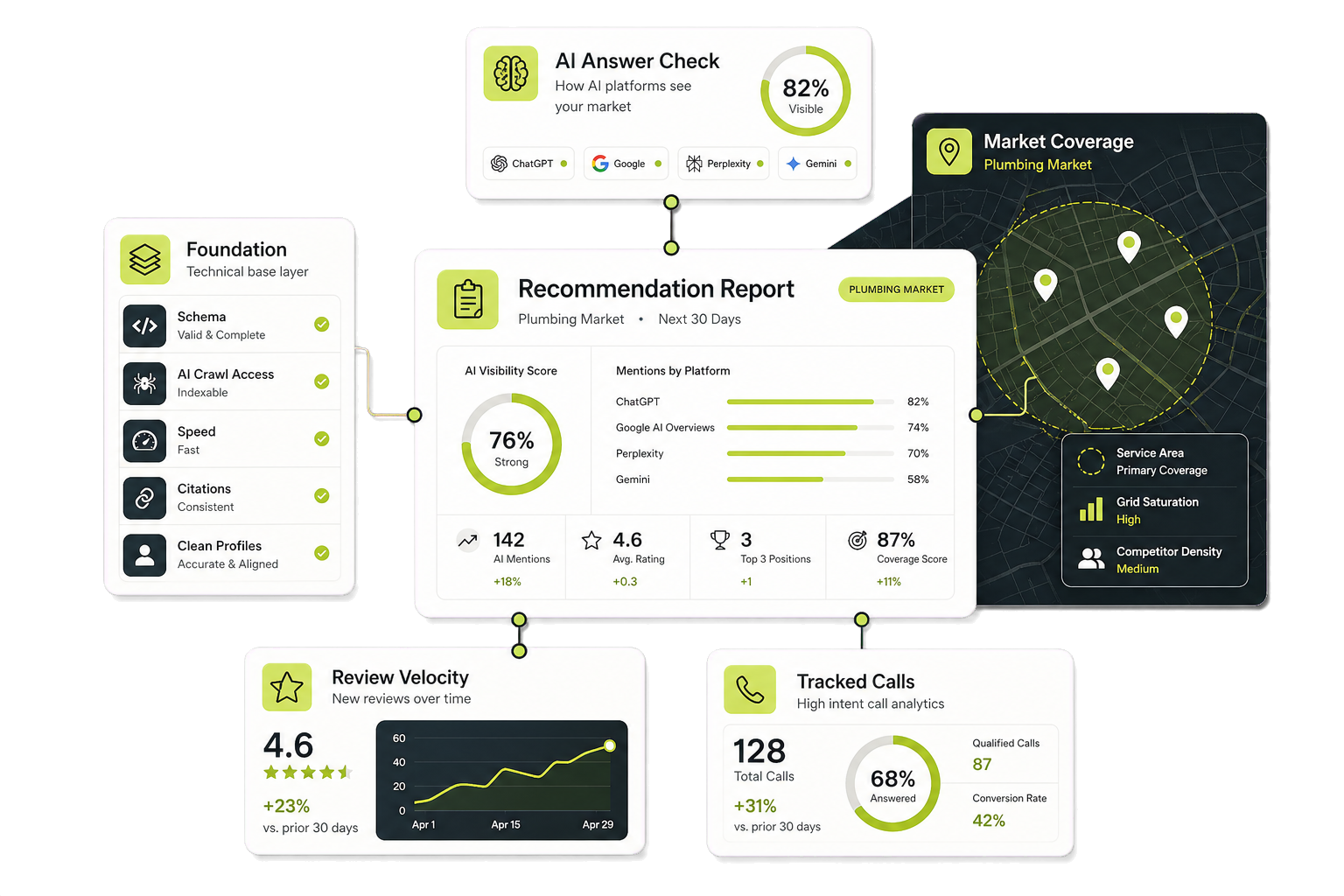
The Recommendation Report is not the intelligence. It is the intelligence made readable. The work does not wait for the report to come out. The report is how you catch up with it.
What moved, by area
Where search and AI changed their answer
The pages, calls, and forms that created real opportunities
The one constraint holding the next move back
What gets tightened next
Tell us how the business runs and what you want more of. We will walk through what is already connectable, where the footprint is thin, and which of the four is holding you back.