

The short version
You can now find out for free on Bing. Microsoft's free account for website owners lists the questions where Bing's AI names other companies and not yours. Ask whoever runs your website for that list, cross off questions with a rival's name, check the rest in ChatGPT and Google, and fix the one page that keeps losing.
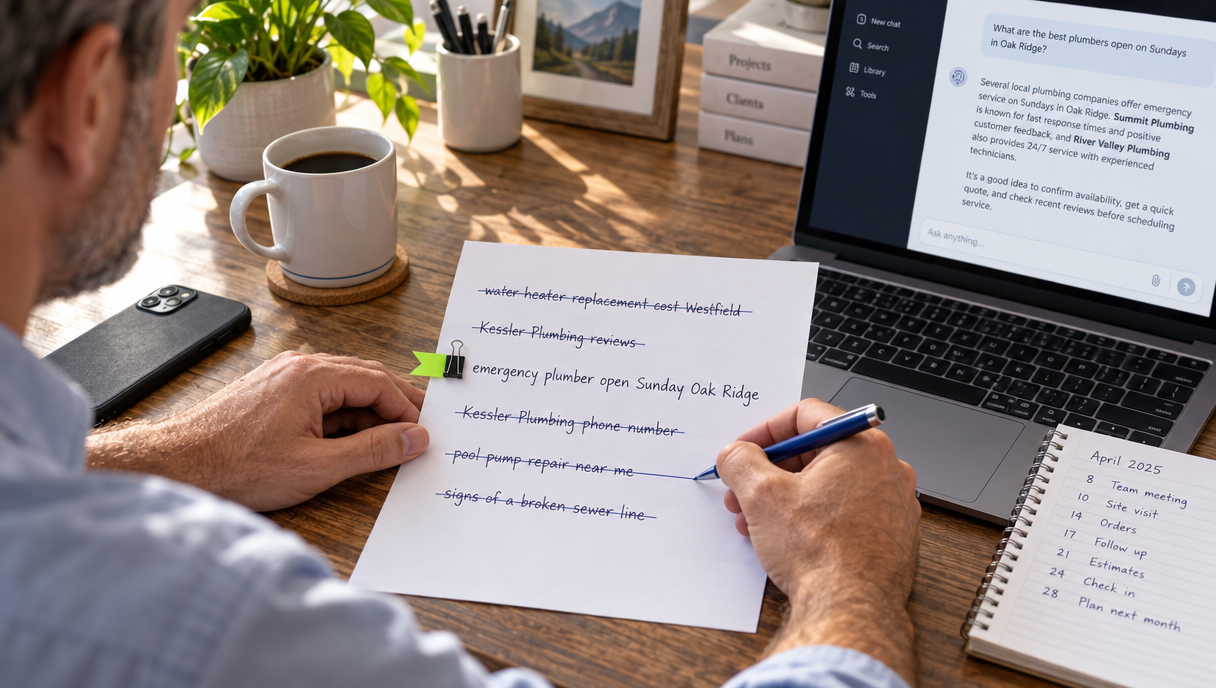
You can find out now, for free, at least on Bing. Since October, Microsoft's free account for website owners, Bing Webmaster Tools, shows a list of the questions where Bing's AI names other companies and leaves yours out. Ask whoever runs your website for that list, cross off the questions about a competitor's company name, type the rest into ChatGPT and Google, and you'll know which page on your site to fix next.
Microsoft announced the list in October as an early test version. You don't need to open it yourself; whoever runs your website can pull it in a few minutes. Reading it takes more care, because it mixes in other companies' names, the numbers are rough, and Bing is only one of the places homeowners ask. Read it wrong and you spend a month chasing a rival's company name.
Bing now shows the questions where its AI picks someone else
When someone asks Copilot, Microsoft's AI assistant, a question, or gets the AI answer at the top of a Bing search, the AI runs its own searches to find pages it can quote. Those searches are what Bing's list shows. Search Engine Journal describes them as the search terms Bing's AI uses to find pages for its answers in Copilot, in Bing's AI summary and in some partner products. So they read like short search phrases, not the exact words a homeowner typed.
Next to each one, the list tells you that other sites got named in the answer and yours didn't.
The list is built from your company, not your whole trade
Microsoft says the questions come from your own site's showing in its AI answers, not from a general list for an industry. That makes the list about you: the work and the towns Bing's AI already connects to your company, and the questions right next to them where it picked someone else. Those are the closest misses you have, and the cheapest ones to win back.
Ask whoever runs your website to send you the list
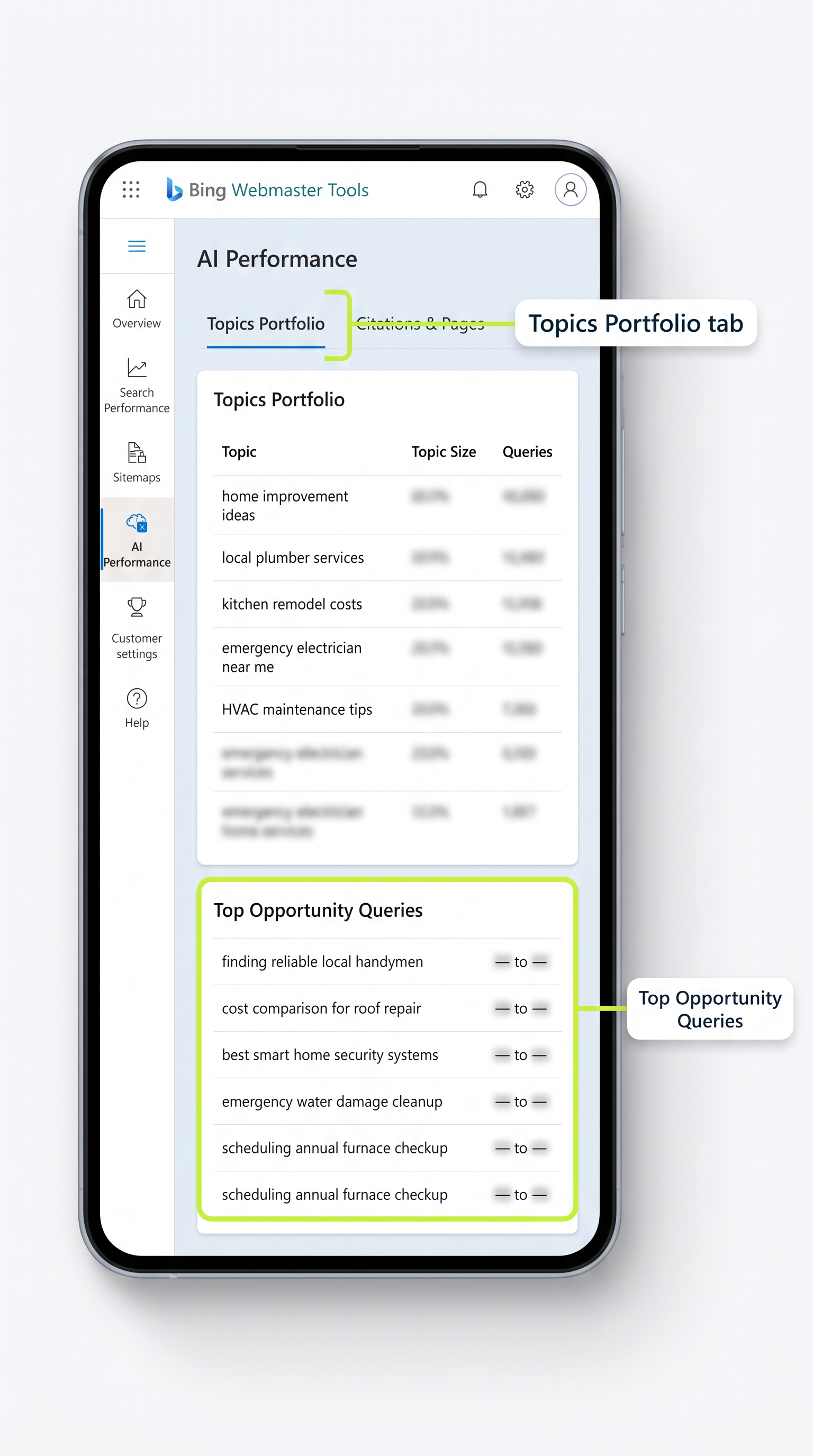
You only need one thing from whoever runs your website. In Microsoft's words, it's the Top Opportunity Queries list, on the Topics Portfolio tab of the AI Performance report, which is the part of Bing Webmaster Tools that shows how your site does in Bing's AI answers. It's Bing's short pick of the strongest questions, across all your work, where other companies get named and you don't.
Forward that sentence as it is. If they want to dig further, Bing sorts the questions into groups, say everything about water heaters. Each group opens into two tables: the questions where your site already gets named, and the questions in that same group where other sites do and yours doesn't. The short list pulls the strongest of those from every group, so it's the one to start with.
No list doesn't mean AI never names you
Microsoft says groups without enough activity aren't shown, so smaller sites may get a short list or nothing at all. It hasn't said how much data is enough. As PPC Land put it, a site can't know ahead of time whether it qualifies, and a missing topic doesn't mean the site is never named there. The whole feature is still a test version with no date to come out of testing, so what's on the screen may change.
So if your website person comes back empty-handed, Bing doesn't have enough to go on yet. Run the questions by hand instead. Write down your three biggest jobs and the three towns where you want more of them, put each job and town together the way a homeowner would type it, and you have nine questions to test in ChatGPT and Google the same way as below. If you'd rather start with a picture of where you stand, the Search Checkup shows what AI says about you.
Cross off any question with another company's name in it
Microsoft says questions about a specific company by name can show up on the list, and its announcement offers no way to filter them out. Those are questions like a rival's phone number or their reviews. No page on your website is going to answer someone looking up another company, so they come off first.
Then cross off the work you don't do and the towns you don't drive to. Each question has a thumbs up and a thumbs down button, so whoever runs your website can mark the ones that don't fit your business as they go.
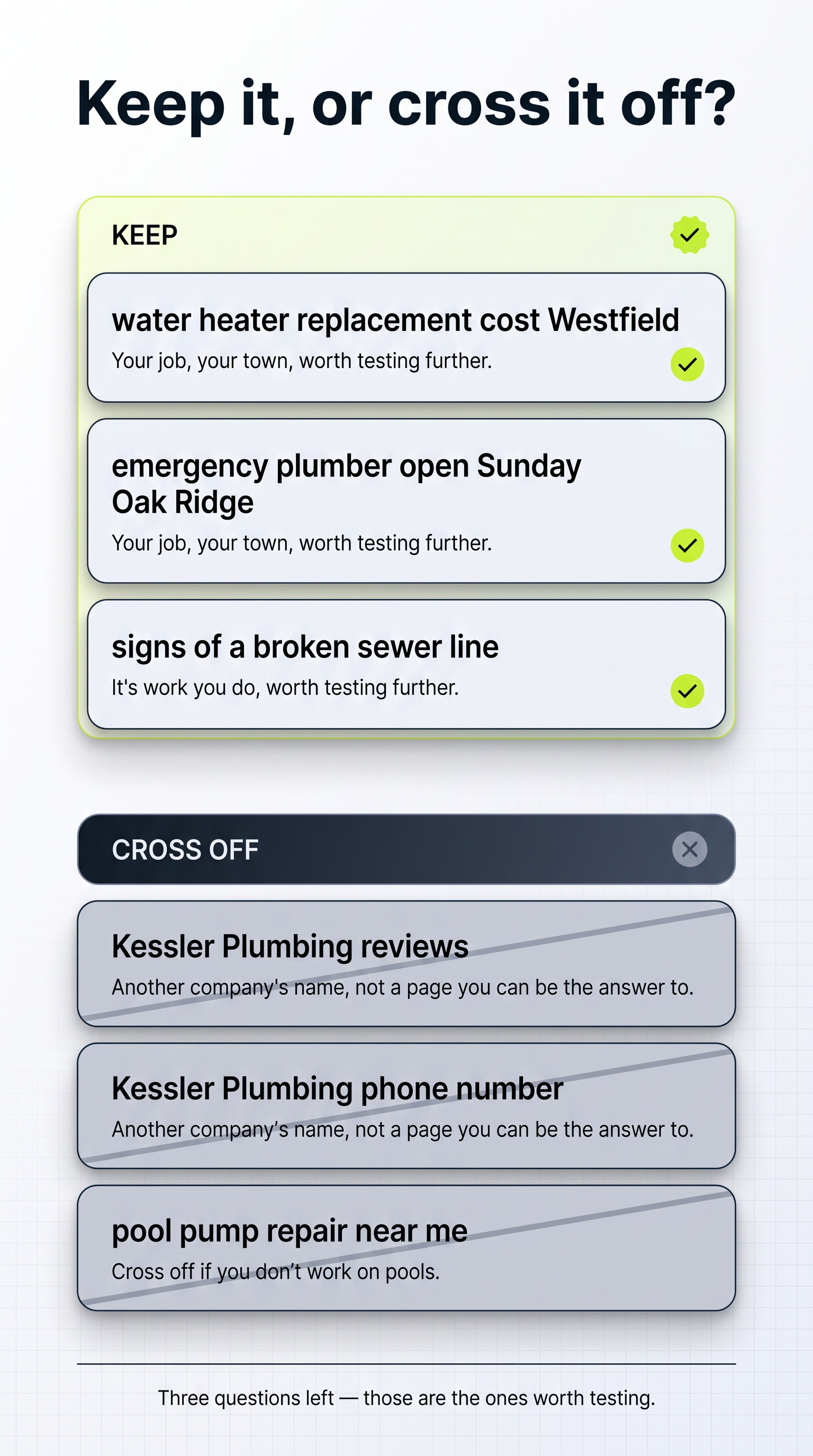
Say you run a plumbing company that covers Westfield and Oak Ridge, and the list comes back with these six:
- water heater replacement cost Westfield: keep. Your job, your town.
- Kessler Plumbing reviews: cross off. Another company's name.
- emergency plumber open Sunday Oak Ridge: keep.
- Kessler Plumbing phone number: cross off.
- pool pump repair near me: cross off if you don't work on pools.
- signs of a broken sewer line: keep. It's work you do.
Three questions are left, and those are the ones worth testing. The same sorting works in any trade; for plumbing companies, here's how AI answers choose which plumber to name.
Trust the questions more than the numbers next to them
Next to each question is a count of how often other sites got named for it. Read those loosely:
- The counts show as ranges, not exact numbers.
- They come from a sample, not every time a site gets named. Microsoft said so when it first launched the report.
- Microsoft's own advice: "Treat the numbers as directional signals for planning, not as a precise ledger." Use them to decide where to look, not to keep score.
- The size Bing gives each group counts how often AI answers named sites, not how many people searched. A big group isn't the same as a busy phone.
- An AI sorts the questions into groups, and Microsoft says it can file one somewhere you wouldn't. Read the questions themselves, not just the group names.
Bing also tags each question by the kind of search it is, and one tag is Local. That's a quick way to spot the job-and-town questions. And none of it shows clicks: the report tells you who got named, not who called.
Check the same questions in ChatGPT and Google
CXL, a marketing training company that dug into its own Bing report, points out that Bing is a fairly small share of search next to Google, and that what Bing's AI names doesn't automatically match Google's AI answers or ChatGPT. Their advice is to run the questions yourself in those tools and see who gets named when you don't.
You can do this from your phone. For each question you kept:
- Type it into ChatGPT, word for word, and read which companies it names.
- Type it into Google and read the AI answer at the top, when Google shows one.
- When another company gets named, tap through to the page that got them named, and note whether your website has a page on that same job at all.
A question where someone else gets named in Bing, ChatGPT and Google is a real miss. One where you already show up in ChatGPT and Google but not in Bing can wait.
Fix a page you already have before you build a new one
Microsoft's suggested order is to pick a window of one, two or three months, start with the topics where you're already named the most, then work down the list of misses. CXL saw something on its own site that points the same way: its ten most-named pages ranked around fifth, on average, in regular search results. That's one company outside the trades, not a rule, but it fits the order Microsoft suggests. A page that already shows up has a head start.
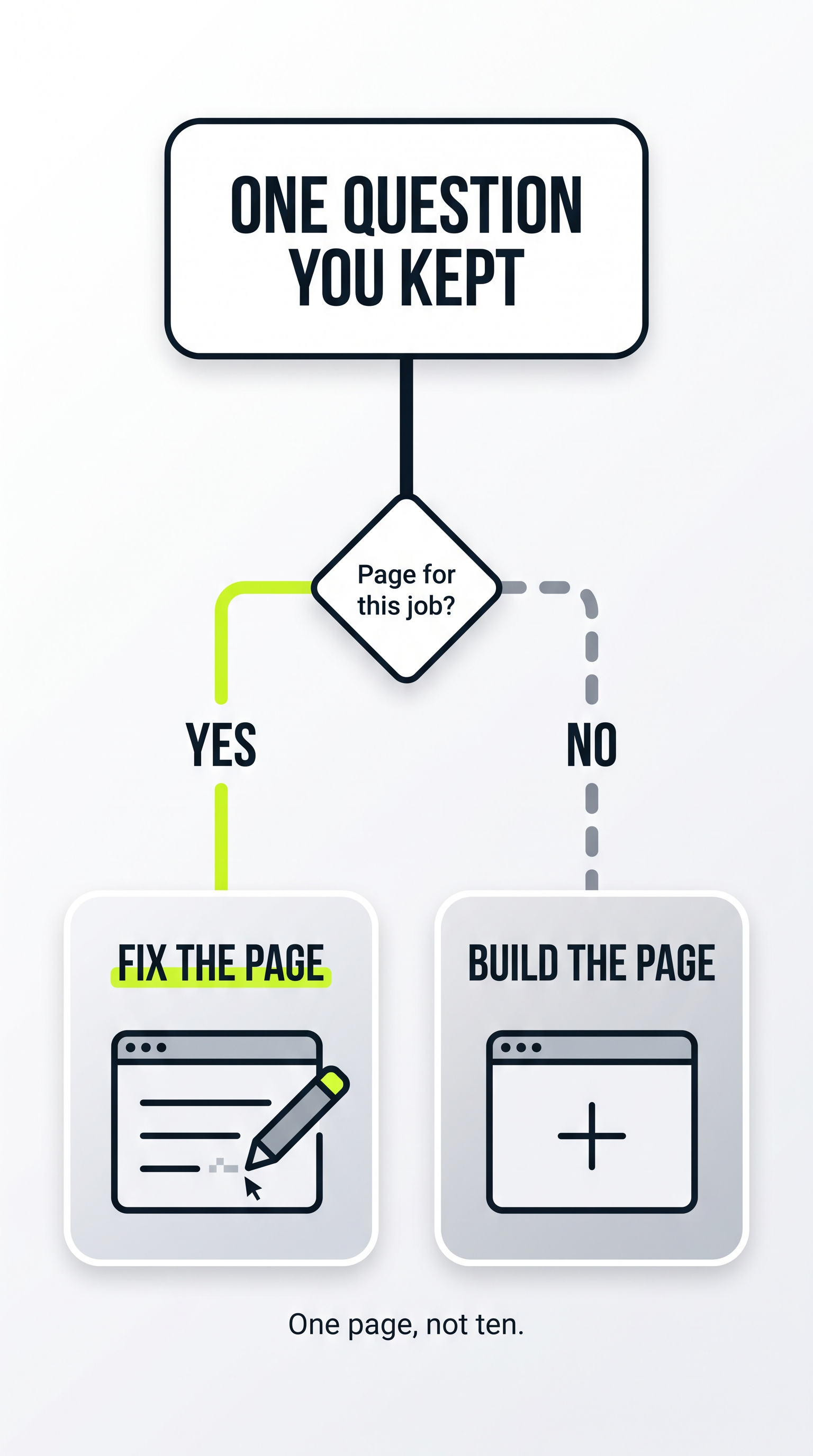
So pick one question and hand whoever runs your website one job:
- Choose the kept question that's work you want more of, where someone else got named in ChatGPT and Google too.
- If your site already has a page for that job, that's the page to fix first.
- If it has no page for that job, that's the one page to build.
One page, not ten. When your window is up, run the same question again in all three places and see whether the answer changed. If your site is missing pages for the jobs you want most, that's a sign to look at a website built around the jobs you want.
One question, one page, then check again
Bing now hands you, for free, the questions where its AI names other companies and not you. Cross off rival names and work you don't do, test what's left in ChatGPT and Google, and put your effort into the one page that keeps losing. This week, ask whoever runs your website for Bing's list. If there's no list, run your nine job-and-town questions by hand.
That cycle of checking the answers, fixing the page and checking again is the work an Agentic Website keeps doing on its own. It reads what the AI answers say about your services and towns, sees which page is losing to whom, works on that page, and then checks whether the answer moved, so the list never turns into a one-time download nobody opens again. If you'd like help turning those questions into pages that get your company named, here's how we approach getting named in AI answers.
Frequently asked.
Are the questions on Bing's list what homeowners actually typed?
No. They are the searches Bing's AI runs to find pages it can quote in Copilot, in the AI summary at the top of Bing results and in some partner products. They read like short search phrases. Treat each one as the job and town being asked about, then type it into ChatGPT and Google yourself to see who gets named.
Why can't my website person find Bing's list of questions?
Bing only shows the list when it has enough data on your site, and Microsoft hasn't said how much is enough. Smaller sites may get a short list or nothing at all. A missing list means Bing lacks data, not that nobody names you, so run your main jobs and towns through ChatGPT and Google by hand.
Can Bing take competitor names off the list for me?
No. Microsoft's announcement offers no filter for that, so questions with another company's name get crossed off by hand. Each question has a thumbs up and a thumbs down button that whoever runs your website can use to mark the ones that don't fit your business.
How often should I check Bing's list again?
Microsoft suggests looking at a window of one, two or three months. Fix one page, give it that window, then run the same question again in Bing, ChatGPT and Google to see whether the answer changed. The counts are rough ranges from a sample, so judge by who gets named, not by small moves in the numbers.