


The short version
Ask whoever runs your Local Services Ads for two numbers, month by month: how many times your ad showed up, and how often it came first on the page. Showing up less but still coming first usually means a slow season. Coming first less often means Google moved you down, and that needs a fix, not a bigger budget.
Local Services Ads are the Google Verified ads at the very top of a search, and Google keeps a number that shows whether yours still comes first: the share of times your ad was the first one on the page. Whoever runs your ads can pull it month by month, right next to how many times your ad showed up at all. Read the two together. If your ad showed up less but still came first, fewer people were searching. That's a slow season. If it stopped coming first, Google moved you down, and something in the account needs a look.
Here's what that looks like when it happens. One owner posted on a local search forum that his ad went from coming first 76% of the time to about 8%. His budget hadn't changed, and it was already set to the maximum. His calls and messages from the ads fell from about 40 a day to about 5. More money was never an option. The number that pointed at the real problem was the one most owners never ask to see.
Google keeps two numbers on every Local Services Ad
The first is how many times your ad showed up in searches over the dates you pick. Google calls these ad impressions. Every time a homeowner searches and your ad appears on their screen, that's one.
The second is how often your ad came first: the share of those times it was the very first ad on the page, above every other paid ad. Google calls this the absolute top impression rate. If your ad showed up 100 times and came first in 60 of them, that number is 60%.
A close cousin is worth asking for too: the share of times your ad showed anywhere above the free search results, which Google calls the top impression rate. Next to how often it came first, it tells you whether you slid from first to second or dropped off the top of the page.
For a feel of real numbers, one account appeared 9,223 times from January 1 to January 31 and was the first paid ad 52.68% of the time. That's one account, not a target. The only fair comparison for your number is your own last few months.
All of it sits under the Reports tab in your Local Services Ads account. You don't need to log in. Whoever runs your ads can send it to you in a few lines. And it matters, because "calls are down" doesn't tell you which number moved, and the two point to very different fixes.
Your ad shows up less but still comes first? That's a slow season
When your ad shows up less and still comes first about as often as before, homeowners are searching less, and you're still winning the searches that do happen. Some of that is the calendar. February has fewer days, about ten percent fewer chances at a call than January, and it lands in a slow stretch for many home service trades. A roofer after storm season or a restoration company after a dry month knows the feeling.
Some of it is the page itself. Early data says Google's newer AI map results show about a third fewer businesses than the old layout. Fewer spots on the page means fewer chances to appear.
In this pattern, nothing is broken. A bigger budget can't make more pipes burst. The smart move is to ride it out and make sure every call that does come in gets answered.
Your ad stopped coming first? Google moved you down
When how often your ad comes first drops hard, the season isn't the story. Seasons change how many people search. They don't change who Google puts first when someone does.
That's what happened to the forum owner above. One detail he added: he had paused his ads for six months, and when he turned them back on, they lost ground every day, on a budget that couldn't go any higher.
A good rule of thumb: when a drop feels bigger than the season explains, one of the account problems is usually behind it. If whoever runs your ads tells you "it's seasonal," how often your ad came first is how you check without taking anyone's word for it.
Read the two numbers side by side, month by month
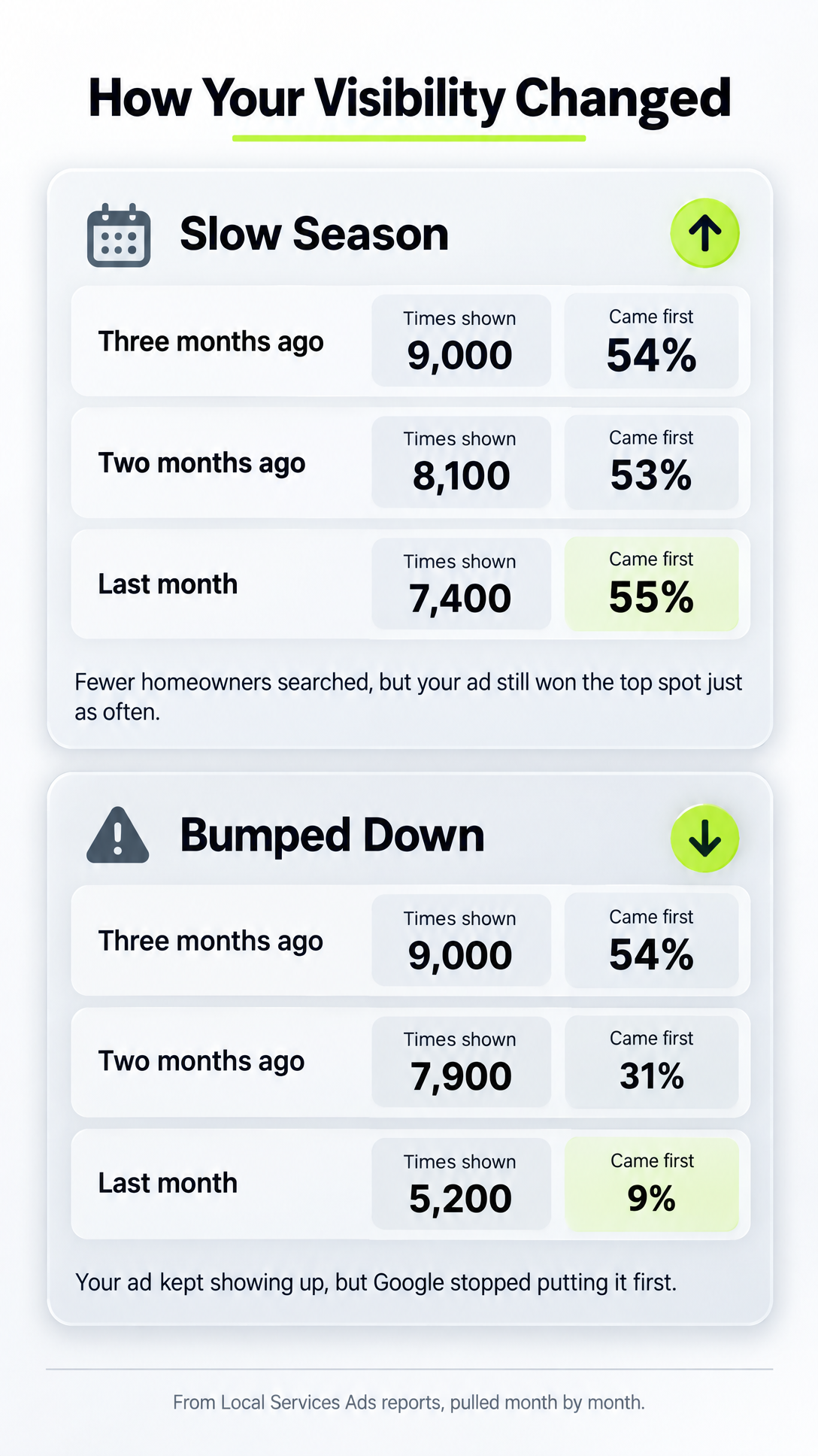
Say you run a plumbing company and the calls from these ads have thinned out. You ask for the last three months. Here are the two answers you could get back.
Slow season
| Month | Times your ad showed up | How often it came first |
|---|---|---|
| Three months ago | 9,000 | 54% |
| Two months ago | 8,100 | 53% |
| Last month | 7,400 | 55% |
Bumped down
| Month | Times your ad showed up | How often it came first |
|---|---|---|
| Three months ago | 9,000 | 54% |
| Two months ago | 7,900 | 31% |
| Last month | 5,200 | 9% |
In the first, the ad shows up a little less each month, and it still comes first just over half the time. Homeowners searched less. In the second, the ad shows up less too, but how often it comes first drops from 54% to 9%. Your ad is still on the page; it just lost the top.
That's why the first number alone can fool you. When you lose the top spot, your ad usually shows up less as well, so both answers start with "we're showing up less." How often it came first is what tells them apart, and the second pattern is the one that needs action this week.
Lost the top spot? Five things get checked first
Google doesn't spell out exactly how much each thing counts toward who comes first. These are the five worth ruling out first, and each one is quick for your ad person to check.
Expired license or insurance can stop the ads cold
The most common reason these ads stop running is an expired insurance certificate or professional license. Your Verified badge rests on that paperwork, so a policy that lapsed last month can take you off the page. Ask for the dates on file.
Google hours that don't match your ad hours can hide you
Take an HVAC company whose ads suddenly stopped showing. Its Google listing said closed on Sundays, while its ads were set to run around the clock. Google flagged the mismatch and hid the ads. Once the hours were fixed, the ads were showing again within 48 hours. Businesses listed as open at the time of a search also rank higher than ones listed as closed. If you take emergency calls at night, your Google listing hours have to say so.
A few missed calls can cost you the spot
In some accounts, just a few missed calls have been enough to make the ads show up less. The moderator who answered the forum owner, who works at a local search agency, put answering the phone at the top of his list: responsiveness and reviews matter most. The forum owner said he hadn't missed any calls, so in his case this one was ruled out. In yours, calls going to voicemail at lunch or after five are worth knowing about first, and answering every call after hours is one way to close that gap.
New bad reviews count, even while the ads are paused
While the forum owner's ads sat paused for six months, four negative reviews came in. The moderator's view is that how often new reviews come in may matter more than how many you have in total. A run of fresh bad ones can weigh more than a pile of old good ones. Ask whoever handles your reviews what came in during the months the calls fell.
A job type that's turned off never shows up
Google doesn't read your website to figure out what you do. If a job type isn't turned on in your Local Services Ads, you won't show for those searches at all. Picture a restoration company that added mold removal last year but never had it switched on in the ads: every homeowner searching for mold removal sees someone else. Ask for the list of job types that are on.
If all five check out, look at how far your ads reach
Google favors businesses closest to the person searching. The forum moderator's suggestion for the owner who lost his spot was to shrink the service area to towns near the business address, then add areas back as calls build. A smaller map where you come first can bring in more calls than a big map where you never do.
What to send whoever runs your Local Services Ads
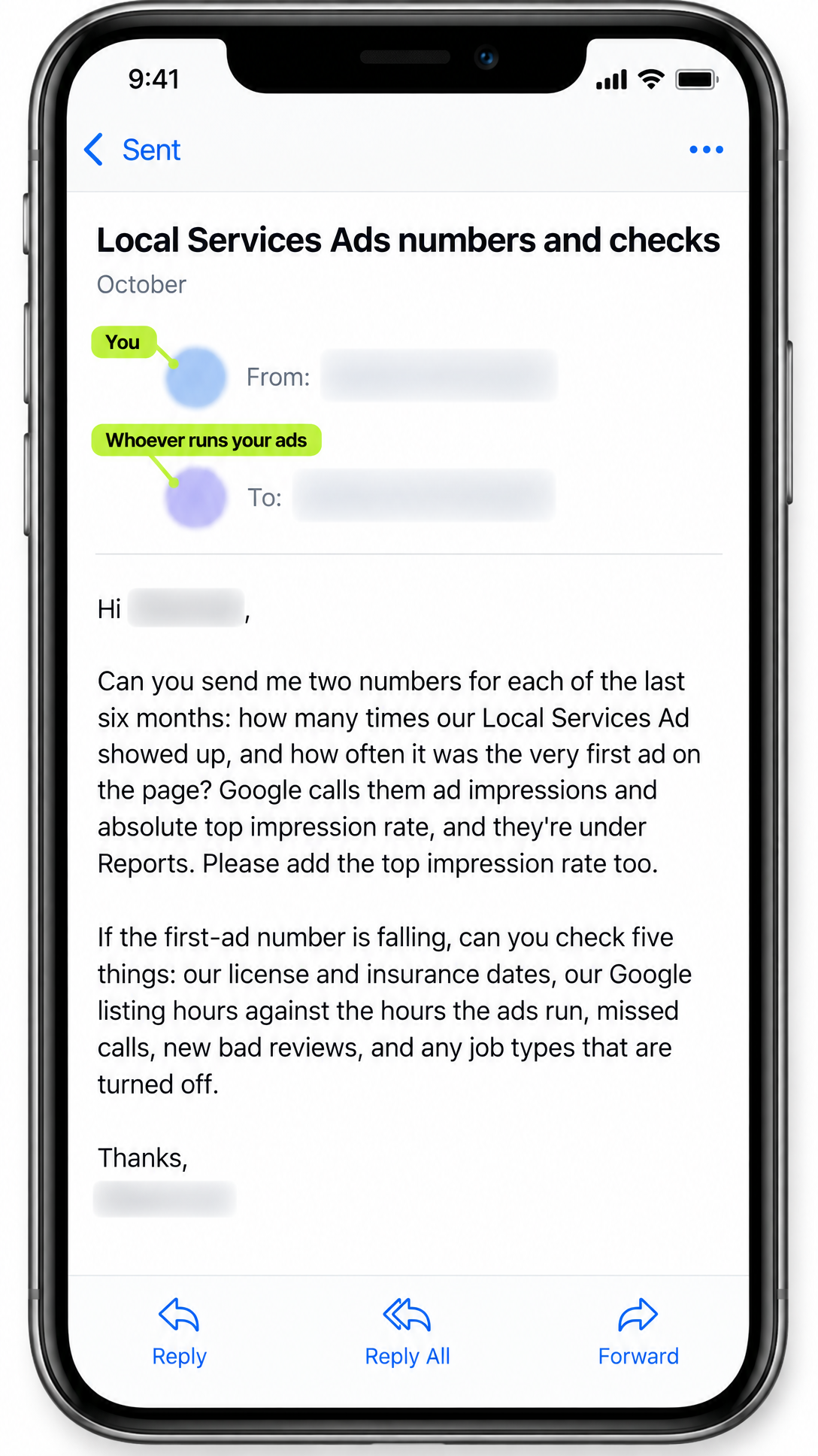
You don't need to open the account. Send one email:
Can you send me two numbers for each of the last six months: how many times our Local Services Ad showed up, and how often it was the very first ad on the page? Google calls them ad impressions and absolute top impression rate, and they're under Reports. Please add the top impression rate too.
If the first-ad number is falling, can you check five things: our license and insurance dates, our Google listing hours against the hours the ads run, missed calls, new bad reviews, and any job types that are turned off?
If the answer comes back "it's the season," you'll see at a glance whether the numbers agree. Going forward, both numbers belong in every monthly report, next to the calls that came in, not only when the phone goes quiet. Here's what a monthly report can show when it's built around booked work.
Know which drop you have before you change anything
When calls from your Local Services Ads drop, two numbers tell you why. If your ad shows up less but still comes first, fewer people are searching, so ride it out and answer every call. If it stopped coming first, Google moved you down, and license and insurance, hours, missed calls, reviews and job types are where to start. Either way, you'll know before you raise the budget or blame the weather.
If you want to see who's sitting above you right now, the LSA X-Ray shows which companies come up in Local Services Ads in your town and where you rank. And if you'd rather have someone watch both numbers every month and act the moment the top spot slips, here's how Axis37 runs Local Services Ads.
Frequently asked.
Can I raise my budget to get my Local Services Ad back to the top spot?
Not when what fell is how often your ad comes first. In the forum case, the owner's budget never changed and was already at the maximum, yet his ad went from first 76% of the time to about 8%. When your ad stops coming first, look at the account: license and insurance, hours, missed calls, new bad reviews and job types that are turned off.
How often should my Local Services Ad come first on the page?
There's no published target. One account was the first paid ad 52.68% of the time in January, but that's one account. The useful comparison is your own number against your last few months, since a steep drop is what tells you Google moved you down.
Does February always bring fewer calls from Local Services Ads?
Often. February has fewer days, about ten percent fewer chances at a call than January, and it's a slow stretch for many home service trades. If the drop is much bigger than that, or your ad also stopped coming first as often, one of the account problems is usually behind it.
How fast do Local Services Ads come back after a fix?
It depends on the problem. In one case, an HVAC company's ads were hidden because its Google listing said closed on Sundays while the ads ran around the clock. After the hours were fixed, the ads were showing again within 48 hours. That's one example, so ask your ad person to watch how often your ad comes first, week by week, after any fix.
Do I need to log into my Local Services Ads account to get these numbers?
No. Both numbers sit under the Reports tab in the Local Services Ads account, so whoever runs your ads can send them to you. Ask for how many times your ad showed up and how often it came first, for each of the last six months.