
The short version
Yes. Since October 1, 2026, Google can bill a Local Services Ads call nobody answers if it rings during your listed business hours and the caller stays on past 20 seconds. It only happens inside both your ad schedule and your listed hours, so set both to the hours someone really picks up.
Yes. Since October 1, 2026, Google can bill you for a call from your Local Services Ads (the Google Verified ads at the top of a search) that nobody picks up. It happens when the call rings during the business hours you list and the caller stays on the line past 20 seconds. Search Engine Roundtable reported the change.
SearchLight's September 2026 benchmark put a lead from these ads at $62.88 across the contractors it tracks, so a ring nobody answers is real money. The good news is that you decide which hours count, and the next section shows the two settings that do it. Your listed hours used to be information for customers. Now they work like a price you set.
Most owners signed up for these ads on a simple deal: you pay when a customer contacts you, not when someone clicks. That part still holds. Someone who taps your ad and leaves without calling costs nothing. What changed is that a call can now count even when nobody on your end said a word.
A missed call is billed only inside both your ad schedule and your listed hours
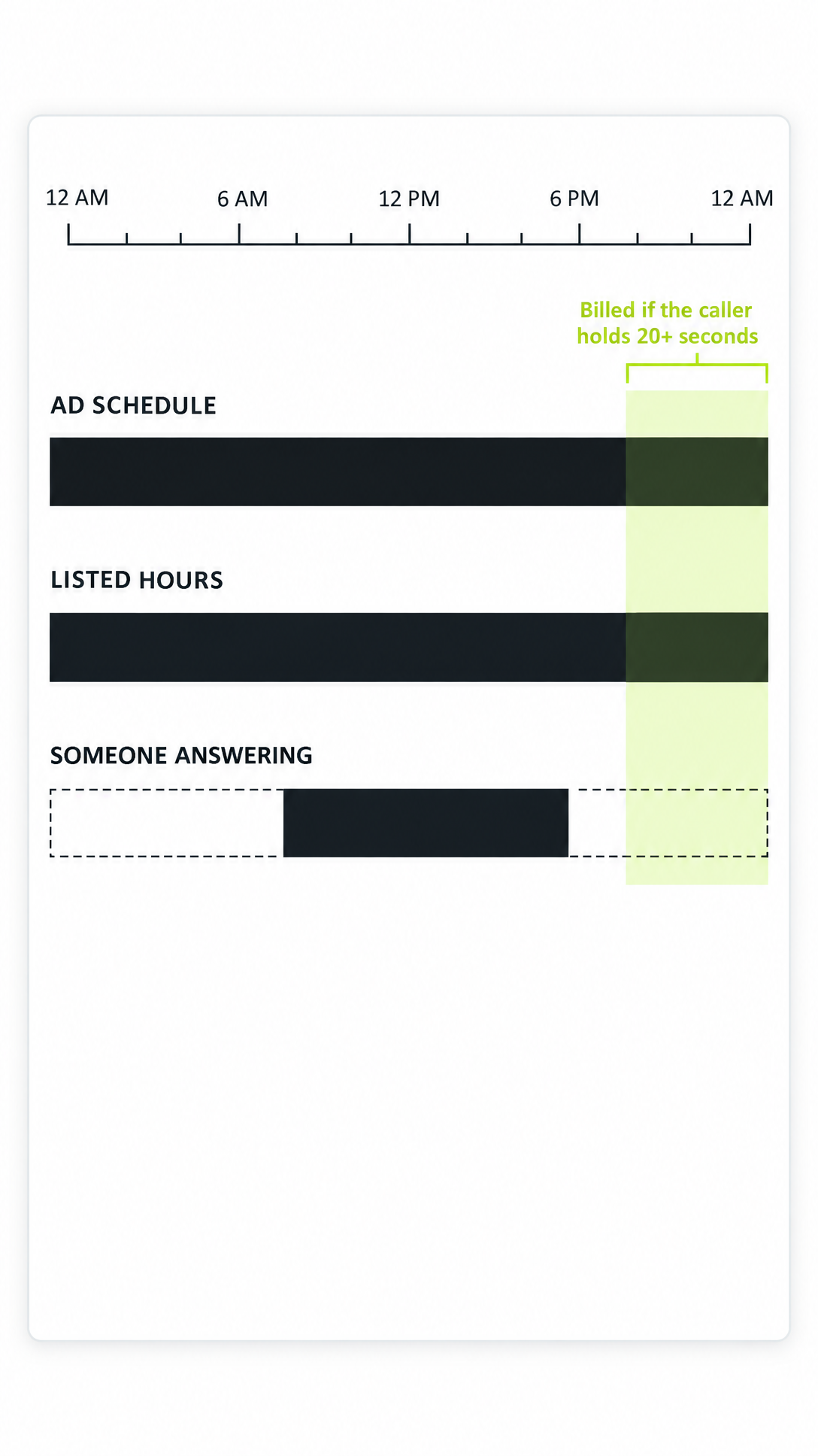
Two settings in your account decide when a ring can cost you. The ad schedule is when Google shows your ad, and Google sets it to All day unless you change it. The business hours are the hours you tell Google you're open. A missed call can be billed only when it lands inside both.
Inside those hours, here's how each call is judged:
- Nobody answers and the caller stays past 20 seconds: Google can bill it.
- Someone answers: Google bills it, however short the call. There is no minimum length.
- Your phone asks callers to press a key first: the 20-second clock starts at the key press. A caller who hangs up before pressing anything isn't billed.
- The same number calls back within 15 days: not billed again, as long as there was contact in that stretch. After 15 quiet days, a new call counts as a new lead.
- A follow-up call after a first call that wasn't billed: it can be billed if it meets Google's rules for a real lead.
So the deciding move is simple. When your ad schedule and your listed hours both match the hours someone really answers, you only pay for missed calls during hours you actually had a person there to take them.
Round-the-clock hours with nobody answering at night are where the money leaks
Say you run a plumbing company. You list your hours as open 24 hours so the burst-pipe calls find you, and the ad schedule still says All day because nobody touched it after setup. The office empties at 5:30. After that, calls roll to the on-call tech's cell, and half the time he's under a sink, driving, or asleep. Every ring he can't grab, where the caller holds past 20 seconds, now lands inside both settings.
Say that's ten calls a month. Billed like any other lead, somewhere near that $62.88 mark, that's about $630 a month for calls nobody talked to. And the caller who hung up at 25 seconds most likely dialed the next company in the ads.
This leak hides because the charge shows up in the ad account and the missed ring shows up in the phone log, and nobody reads the two side by side. An Agentic Website is built to read the ads and the phone together, so a gap like this shows up before the bill does. Until then, you know better than anyone how many night calls your on-call phone really catches. That number, not the hours printed on your truck, is what your listed hours should reflect.
Set your listed hours and ad schedule to the hours someone really answers
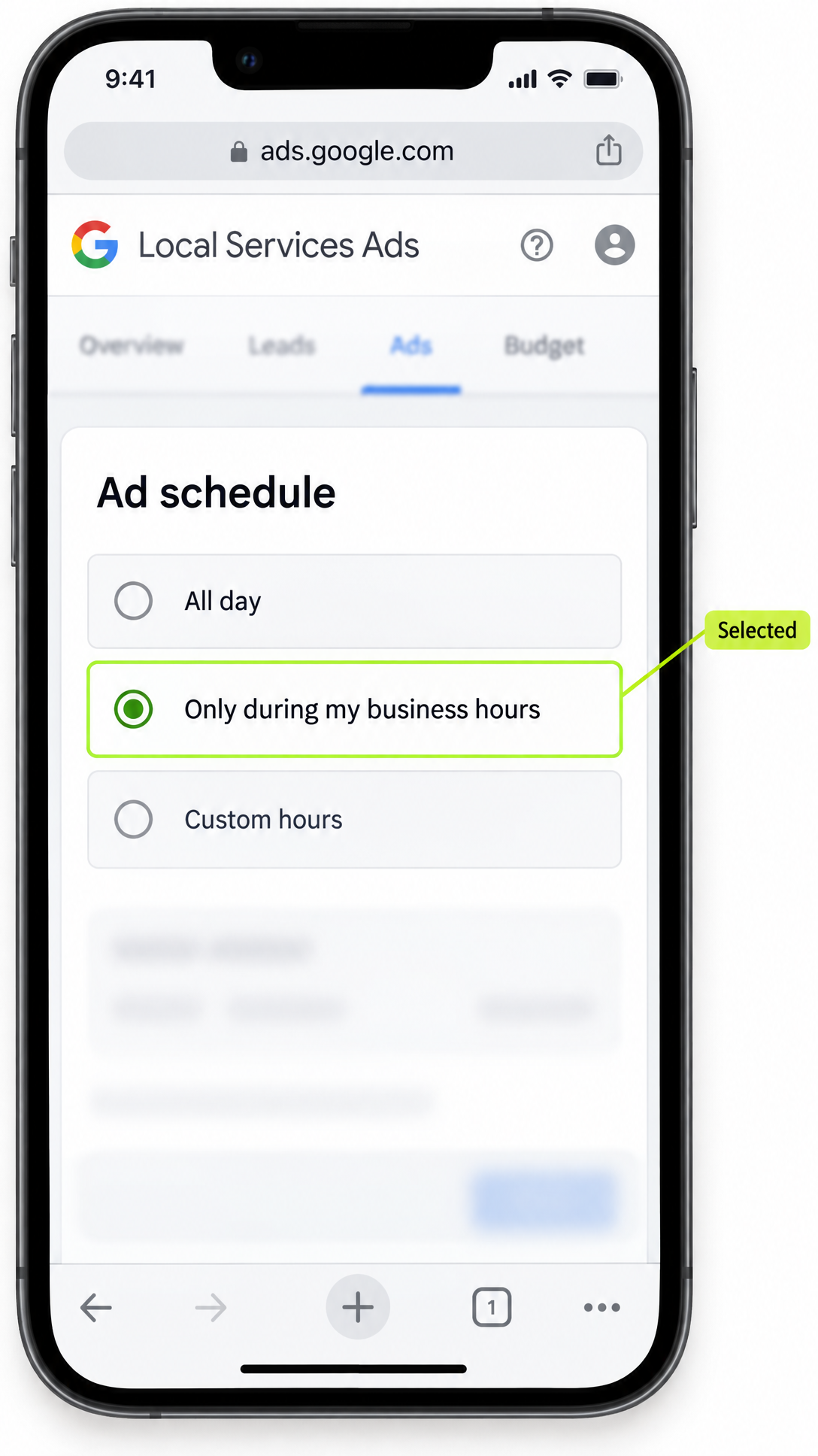
The ad schedule has three choices: All day, Only during my business hours, and Custom hours. Next to it are the business hours themselves. The fix is making both tell the truth about when a person answers your phone.
Start with an honest list. Day by day, write down the hours someone actually picks up a call from these ads. Not the hours on the office door. The hours a real person grabs the phone. Then you have two honest choices.
Shrink the hours to fit the phone. Set your business hours to that list. Then switch the ad schedule from All day to Only during my business hours, or to Custom hours if you want a different pattern. A missed call outside those hours stops being billable, because it no longer lands inside both settings.
Or keep the hours and answer them. If night emergencies are your best-paying work, cutting the hours trades a missed-call bill for missed jobs. The other way is making sure every hour you list has someone answering: an on-call person who reliably picks up, or a service that answers your phone after hours. An answered call is billed too, but you get a customer on the line instead of a ring you paid for and lost.
One heads-up before you go looking. Google started moving these ads into Google Ads in August 2026, beginning with some US home service companies, so these settings may sit in a different spot in your account than they used to.
Job types and zip codes stop the calls Google won't pay back
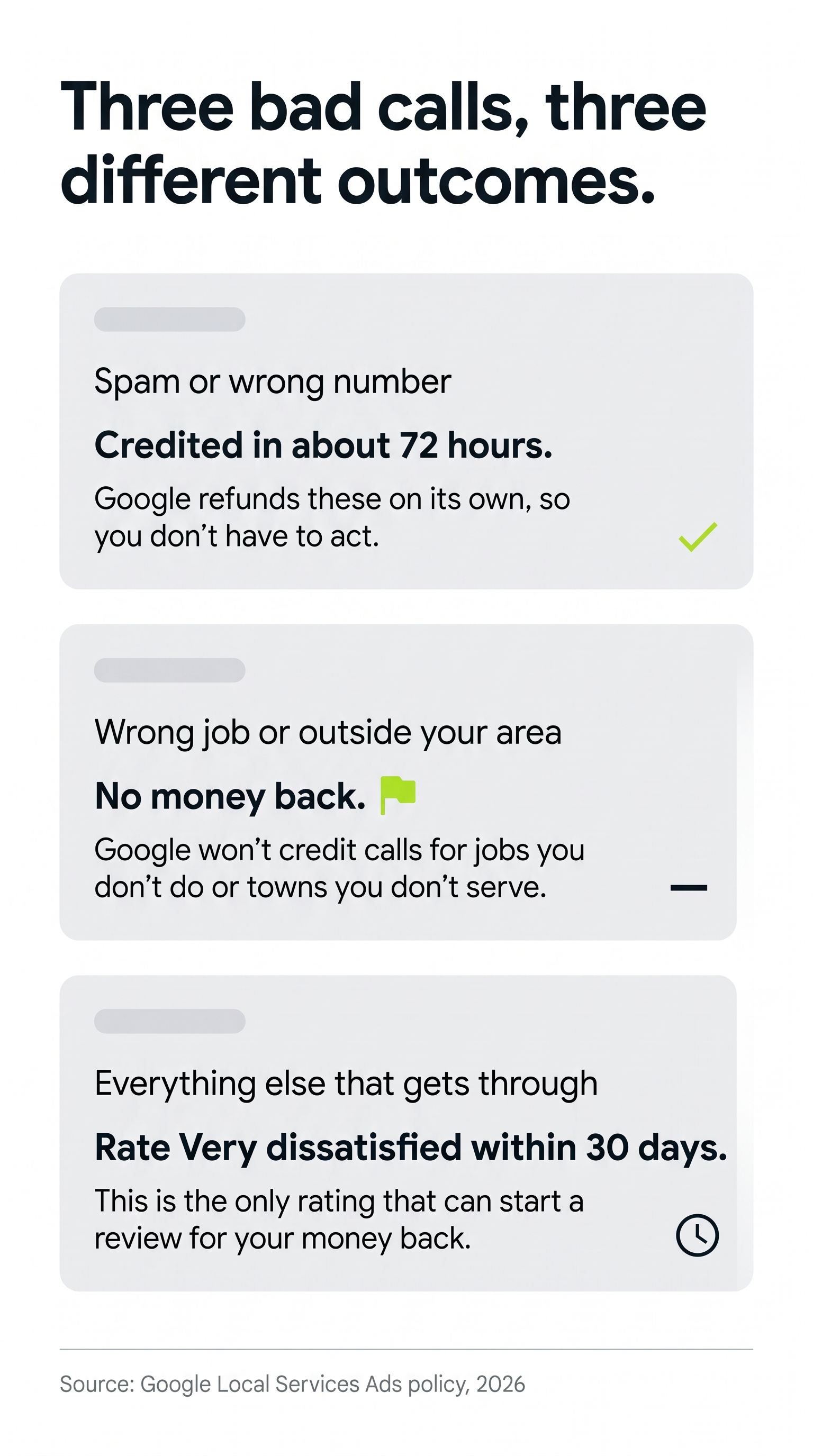
Your hours aren't the only setting that decides what you pay for. Google no longer gives money back, which it calls a credit, for calls from outside your service area or for services you don't offer. The only way to stop paying for those calls is to keep your zip codes and job types tight. That makes your services, your service area and your hours the main cost controls you fully own now, so give these the same honest look you just gave your hours.
- Job types. Every service you check is a door for calls. A roofing company that left gutter cleaning checked because it was on the list at setup pays for gutter calls it turns away.
- Zip codes. An HVAC company whose list still covers the towns across the river it stopped driving to pays for the calls from there too.
Uncheck any job you'd hand to someone else, and drop every zip code your trucks don't go to. If you'd rather not dig through every setting yourself, see how we manage Local Services Ads for home services companies.
Rate the bad calls that still get through within 30 days
Google credits clear spam and wrong numbers on its own, usually within about 72 hours. For everything else, rating the call in your account within 30 days is the only way to ask for money back.
- Listen to the recording first. Every call from these ads is recorded. Confirm the call was really bad before you rate it.
- Pick Very dissatisfied. It's the only rating that can start a review for money back. Somewhat dissatisfied tells Google how you feel but rarely gets a credit.
- Make it a daily or weekly job. Ratings sent after 30 days aren't looked at.
Decisions come with no explanation, they're final, and there's no appeal. That's why rating calls is cleanup, not the plan. The plan is the hours, the job types and the zip codes, set so the calls you'd fight over never get billed in the first place.
Your listed hours now decide what you pay for missed calls
Google can now bill a call nobody answered, but only inside the hours you told it you'd be there. Make those hours true and that charge has nowhere to land.
Tonight, open your Local Services Ads account and put the business hours and ad schedule next to the hours someone really picks up. Change the settings to match, or get every listed hour answered. If the honest answer is that nobody reliably picks up after the office closes, an AI receptionist can answer those calls, so the hours you keep listed bring you customers instead of charges.
Frequently asked.
Does Google charge for an answered Local Services Ads call that only lasts a few seconds?
Yes. Answered calls are billed with no minimum length, so a quick call still counts. Clear spam and wrong numbers are usually credited automatically within about 72 hours, and for other bad calls you can rate them Very dissatisfied within 30 days.
If I miss a call and the same person calls back, do I pay twice?
Not if they call from the same number within 15 days and there was contact in that stretch. After 15 quiet days, a new call counts as a new lead. A follow-up call can be billed when the first call wasn't billed and the follow-up meets Google's rules for a real lead.
Does a press-a-key greeting change when Google starts counting a missed call?
Yes. If callers have to press a key to reach you, the 20-second clock starts at the key press, not when the phone starts ringing. A caller who hangs up before pressing anything isn't billed.
Can I get money back for a Local Services Ads call about a job I don't do?
No. Google no longer credits calls for services you don't offer or from outside your service area. The only way to stop paying for them is to keep your job types and zip codes limited to the work you take and the towns your trucks go to.
How long do I have to rate a bad Local Services Ads call?
30 days. Ratings sent after that aren't considered, so rate calls daily or weekly. Listen to the recording first, then pick Very dissatisfied, the only rating that can start a review for money back. Decisions are final and there's no appeal.