

The short version
In WebFX's 2026 home-services study, map results showed on almost every search, Local Services Ads sometimes took the top, and traditional Google Ads rarely appeared and sat far down. Check the live page before you fund the layer buyers see least.
Open your phone. Search the exact phrase a homeowner would type for your main job in your town ("AC repair near me," "emergency plumber," "electrician [your city]"). Do not open the ad account first. Look at the page the way a buyer looks at it.
You will usually see a map block with a few local companies. Sometimes you will see a special paid block above that map with verified home-service listings. Traditional Google Ads (the familiar sponsored links you have been funding) may not appear at all. When they do, they often sit well below the map.
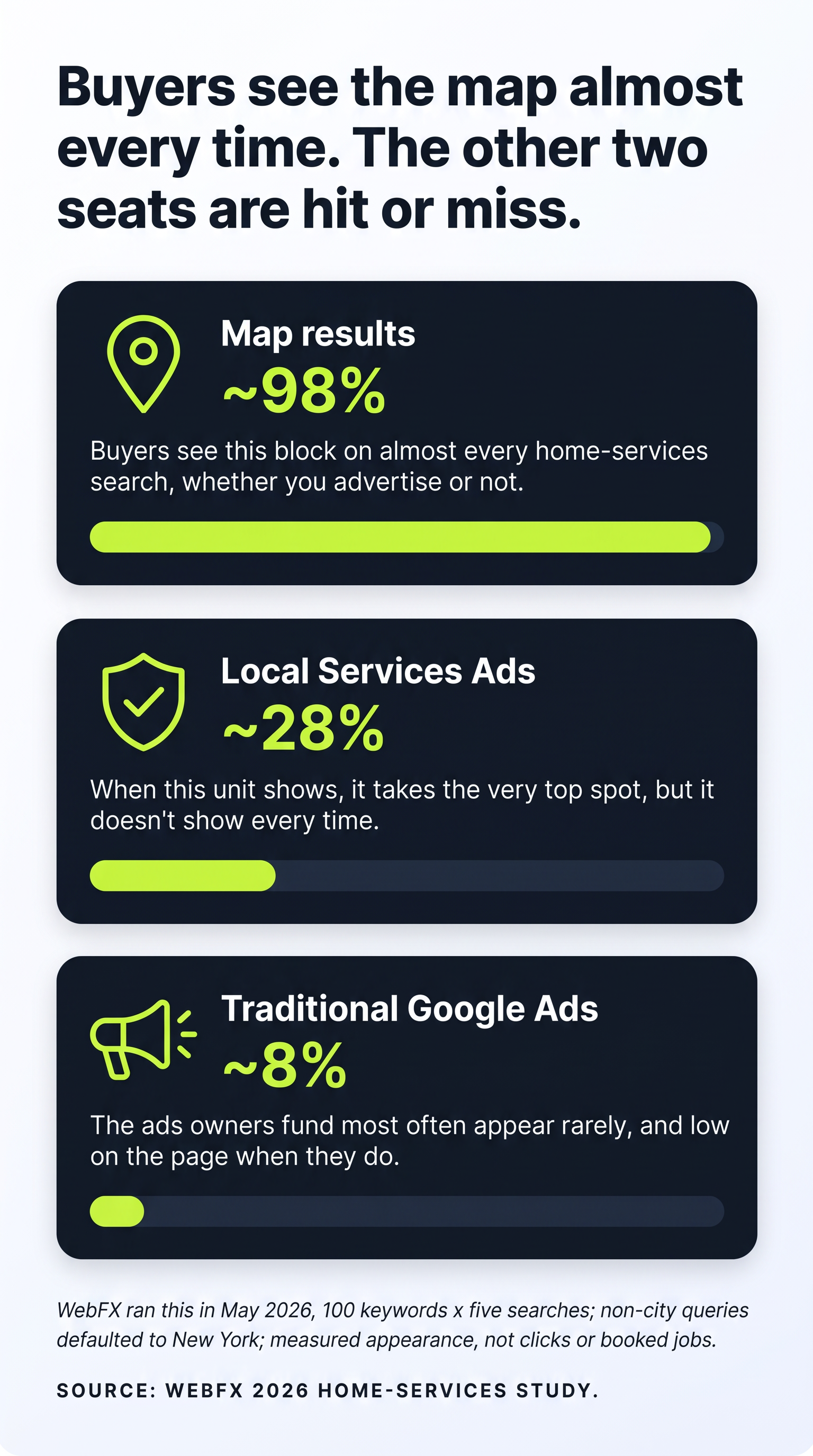
That layout is not a quirk of your market. A 2026 WebFX study of home-services search results measured how often each layer shows up. The map results were nearly always present. Local Services Ads showed up part of the time and took the top when they did. Traditional Google Ads showed up rarely, and low on the page.
If "search" in your budget meeting still means only Google Ads, you are judging the channel by the layer buyers meet last, if they meet it at all.
What are the three layers on a home-services Google page?
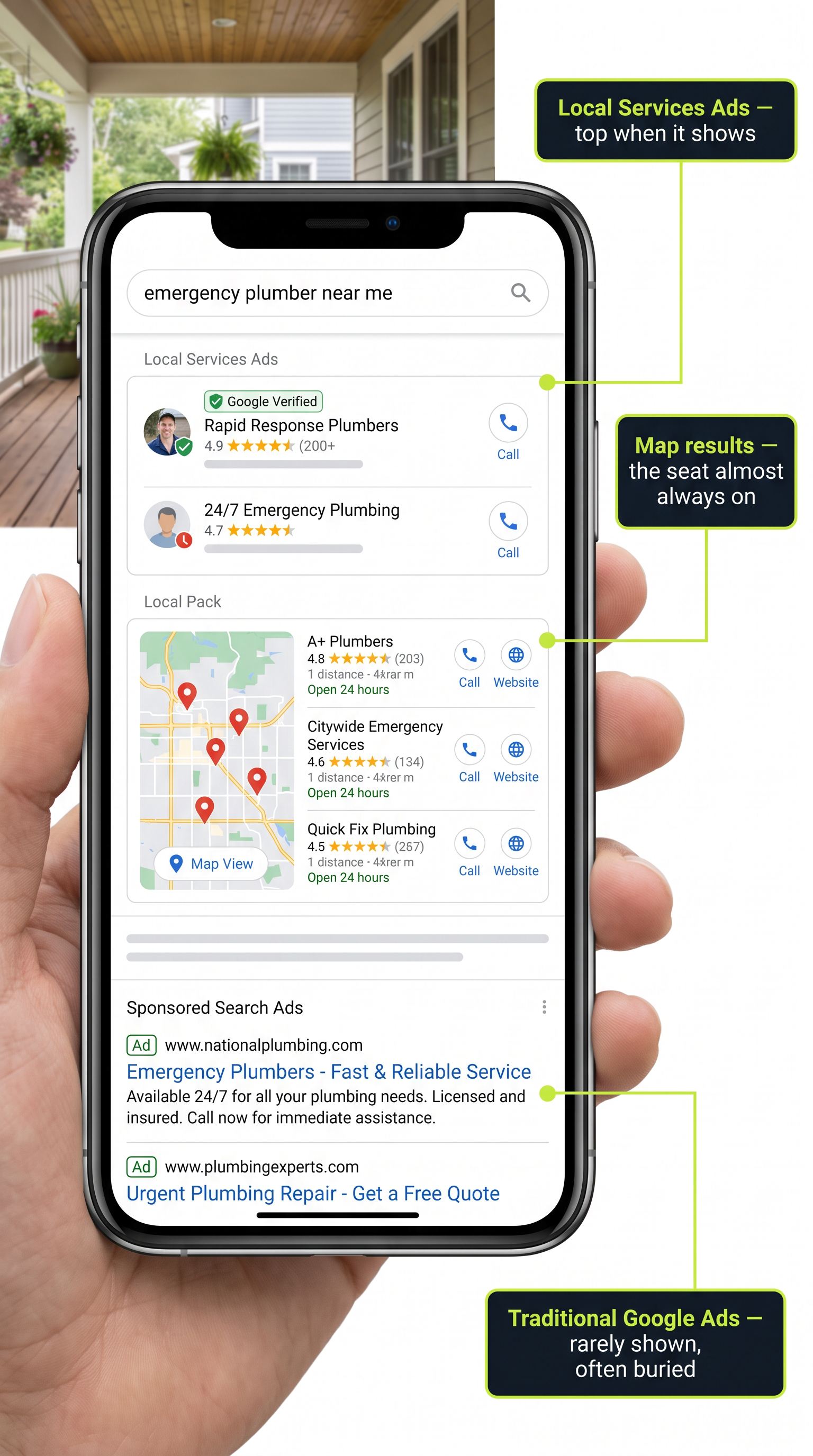
Map results (also called the Local Pack or map pack) are the map plus a short list of local businesses.
Local Services Ads. When Google offers this unit for your trade and the areas you serve, Local Services Ads charge for leads related to the business and services offered. Google shows a block of companies. The homeowner picks one and calls or messages through Google. You pay when that contact counts as a lead, not for every page view. Google Help describes this unit as shown prominently when people search for the services you offer in areas you have chosen.
Traditional Google Ads are the sponsored search ads you already know: you choose keywords, write ads, bid, and send people to your website. You usually pay per click. You control the message and the landing page more tightly than with Local Services Ads.
Same Google search box. Three different seats. Different prices. Different control. Different odds of even being on the page.
Think of it like three different stalls at the same curb. One stall is almost always open for local companies with a strong map presence. One stall is a paid verified booth that Google sometimes puts out front. One stall is the classic paid flyer that often never makes it to the front of the line. Your marketing report may treat the flyer as the whole curb. Buyers do not.
How often does each layer actually show up?
WebFX's 2026 study ran 100 U.S. home-services keywords across HVAC, plumbing, roofing, electrical, and garage door work. Each keyword was searched five times (500 searches total) to measure which features appeared and where they landed.
Here is the topline they published:
- Map results: appeared for 98 of 100 keywords and in 488 of 500 searches, about 98%.
- Local Services Ads: appeared in only 142 of 500 searches, about 28%. When they appeared, they held position 1 every time.
- Traditional Google Ads: appeared in only 42 of 500 searches, about 8%. Average first position when present: 11.3. On 16 of those 26 keywords where ads appeared, the ads landed below position 10.
Caveat on that study: WebFX ran this in May 2026, 100 keywords × five searches, non-city queries defaulted to New York, and they measured whether the unit appeared, not clicks or booked jobs. Appearance will move by city, device, and season.
Read that again against last quarter's invoice. The layer many companies treat as "their search program" was the least visible of the three and, when present, sat far under the map.
Say you only review Google Ads dashboards, you can honestly believe "search is expensive and soft" while the map block (the thing nearly every buyer sees) sits untouched and underfunded in reviews, photos, categories, and response speed.
Why does the map block matter more than the ad account screenshot?
Because buyers look at the page, not your campaign report.
The map block is close to a fixed feature of home-services search. That consistency matters: the most frequent seat on the page is not the one your media buyer optimizes in the Google Ads account tools.
When Local Services Ads are absent, the map leads. When Local Services Ads are present, they sit above the map. Traditional Google Ads rarely enter that top contest.
So the budget conversation is not "Google Ads versus free search" as two abstract channels. It is: who owns the first screen a homeowner sees with a wet basement or a dead AC.
When do Local Services Ads show, and what are you buying?
Local Services Ads are powerful when they surface and unreliable if you treat them as always-on coverage.
Overall, Local Services Ads showed in about 28% of measured searches. City-named queries were the exception, about 49% appearance versus about 25% for other query types. WebFX reads that gap the same way: a city in the query is a stronger local signal.
Local Services Ads can buy you the first seat when Google shows the unit. They do not guarantee that seat on every search. Build the map foundation either way. Layer Local Services Ads where your city-named and high-intent terms actually trigger the unit. Do not confuse "we have a Local Services Ads budget" with "we own the top of every search."
Why do traditional Google Ads still matter if they rarely show up top?
Because visibility and control are different jobs.
The study's appearance rate for traditional Google Ads was low, and average position was deep on the page. That is a visibility problem if you expected them to be the first thing buyers see. It is not an argument that Google Ads are useless.
Traditional Google Ads still let you:
- Defend your brand name when a competitor bids on it
- Push a seasonal offer with your own landing page and phone path
- Cover service lines or ZIP patterns Local Services Ads and the map do not fully cover
- Retarget people who already visited your site
- Feed cleaner keyword-level data into how you judge booked jobs
Measure both paid layers by cost per booked job, not vanity cost-per-lead.
The mistake is using Google Ads as your primary "are we visible on Google?" answer. They lost the job of being your visibility scoreboard. They keep the job of controlled demand capture when you need it. Owners who conflate those jobs either overfund a low-appearance layer or abandon a useful control tool for the wrong reason.
How should you check your own market before you move money?
Do this before you approve another media plan.
What a wrong budget read looks like in a real week. Picture an HVAC company that spends most of its "search" dollars in traditional Google Ads. The weekly report shows clicks, cost per click, and a handful of form fills. The owner asks why the phone is soft on emergency days. Nobody has photographed the live results for "AC repair [city]" from a homeowner's phone.
On that phone, Local Services Ads sometimes sit first. The map block almost always sits next with competitors who answer reviews same-day. The company's traditional Google Ad, when it shows, is under the map and under a few free search listings. The budget meeting has been tuning the wrong seat.
Flip the sequence. Same company spends a short session on those buyer searches. They see the map gap, tighten categories and photos, ask for reviews after every completed job for a stretch, and test a modest Local Services Ads budget only on metros where the unit actually triggers. Traditional Google Ads stay on for brand defense and a spring maintenance offer with a dedicated landing page. The question in the next meeting is not "how were the clicks?" It is "which seat produced booked jobs?"
That is the same marketing dollar. It is a different attention map.
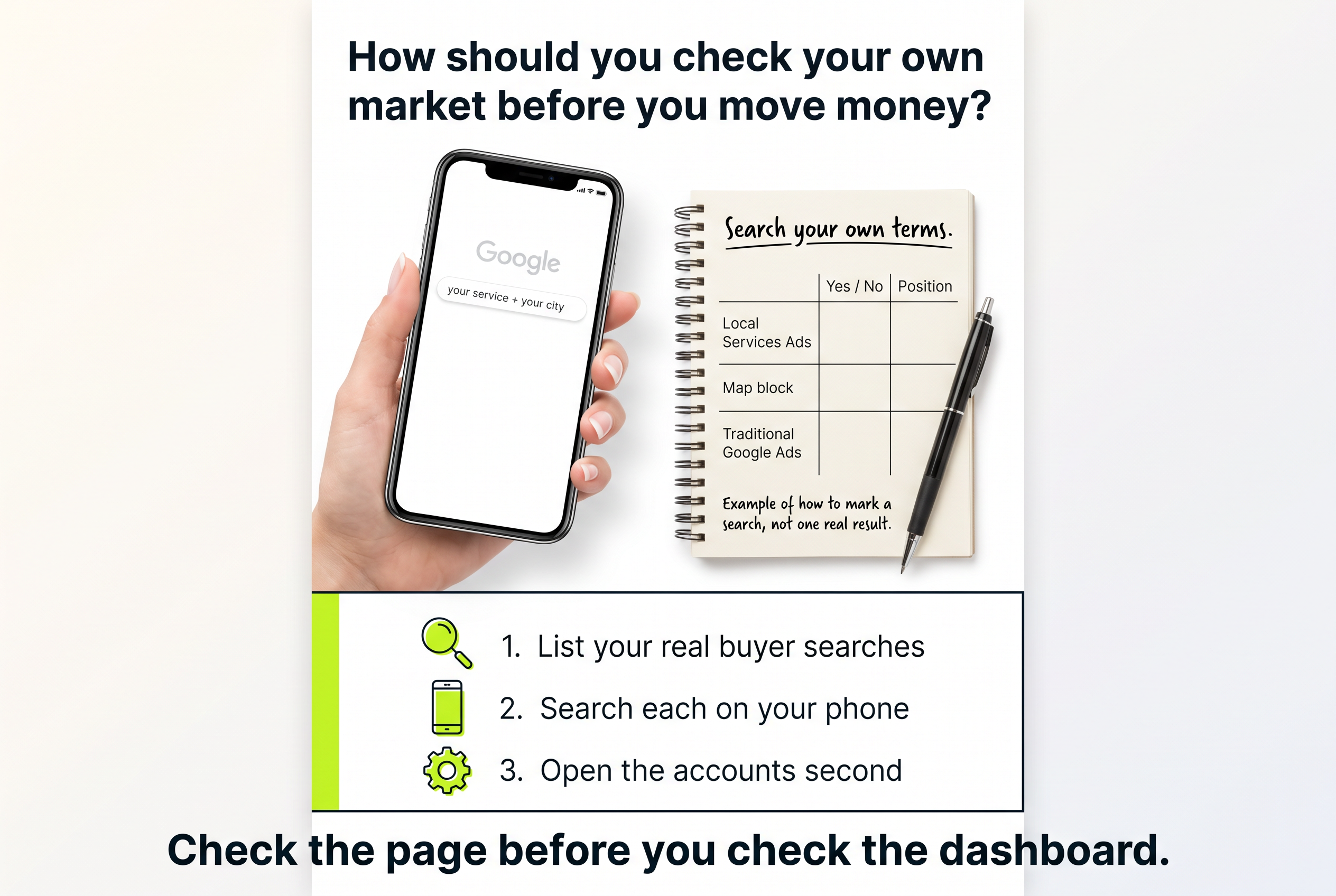
- List your real buyer searches, your top emergency job, your top planned job, one "near me," one "[service] [your city]," one brand-plus-service. Write them the way a homeowner types, not the way a keyword tool labels them.
- Search each on your phone from inside your service area (or ask someone in-area to screen-record). Note these columns: Local Services Ads yes/no, map block yes/no and who sits in it, traditional Google Ads yes/no and roughly how far down. Photograph the results for the team.
- Repeat once from a second ZIP you care about. Appearance can shift with location and city wording.
- Open the accounts second, not first. Compare what the page showed to what the platforms reported. If Google Ads spent money on a term where the ad never appeared above the map, treat that as a layout fact, not a personal failure.
- Score your map seat honestly. Are you in the map for the terms that book trucks? Are photos recent? Are categories exact? Are reviews recent and answered? Fix the map basics that cost little: categories, service areas, photo freshness, review ask after completed jobs, response speed on profile messages. That checklist is your method, not a ranking formula from the study.
- Only then move budget. Put Local Services Ads, map work, and traditional Google Ads on one page with one shared question: which of these produced booked jobs last month? You do not need all three at the start. Start with the map seat you can earn. Add Local Services Ads where the unit actually triggers and your team answers fast. Keep traditional Google Ads for control, brand defense, offers, and coverage gaps, not as the default definition of "search." Refuse any plan that raises one layer without stating how often that layer shows for your terms.
This is a short page check, not a long audit. The page will teach you more than another dashboard screenshot.
If you want a clear read on your own footprint, including how you show up when buyers search nearby, start from a Search Checkup and your numbers, not a generic media mix.
Frequently asked.
How often do map results show for home-services searches?
In WebFX's 2026 home-services study, map results appeared for 98 of 100 keywords and in 488 of 500 searches, about 98 percent. That is the seat nearly every buyer sees before traditional Google Ads.
Do Local Services Ads always sit above the map?
When Local Services Ads appear, WebFX measured them in position 1 every time. They only showed in about 28 percent of the 500 searches overall, and about 49 percent on city-named queries. Treat them as premium when Google shows the unit, not as always-on coverage.
Why keep traditional Google Ads if they rarely show on top?
Visibility and control are different jobs. Traditional Google Ads still help with brand defense, seasonal offers, coverage gaps, and cleaner keyword-level judgment by booked jobs. The mistake is using them as your main answer to whether buyers can find you on Google.