


The short version
Your Google listing and reviews can look fine while ChatGPT still skips you. Name the towns you serve in plain text on the site, keep those facts consistent with your Google listing and structured data, then ask ChatGPT who to call in those towns and compare.
Ranking in the map results and collecting reviews is not the same as giving ChatGPT readable towns, hours, and services. A Whitespark study of 540 local queries across Houston, Phoenix, and Denver found Google's AI answer boxes (AI Overviews) appearing on about 68% of those searches on average, while the map results showed on about 39%. That 68% is an average across those three large metros with remote testers; AI Overview rates ranged about 57% to 80% across the industries in that run, so treat it as a study average, not a rule for one trade in one suburb.
If your Google listing looks strong and ChatGPT still names someone else for the towns you actually serve, one factor worth checking is whether machines can read the same towns, hours, and services you think you already published. Reviews still matter; they are not the whole story when the readable facts disagree.
Why can the map look fine while ChatGPT skips you?
A strong Google Business Profile is the listing owners already edit for categories, reviews, photos, and location. Google's AI answer boxes are measured separately from the map results in the Whitespark study. ChatGPT is a different product again. Map visibility and AI visibility are not the same scoreboard.
Home-services queries are especially uneven. Purely local-intent queries showed AI Overviews far less often (about 15% in Whitespark's intent split), informational queries about 92%, and hybrid queries about 97%.
So an owner who only watches map position can honestly believe "we're fine online" while the assistant a homeowner asked for "an HVAC company that covers Cedar Park and Round Rock" never saw those town names attached to the company in a form it trusted. The same gap shows up in other leaks, like when Google Ads says it converted and the schedule says it did not: the dashboard story and the readable facts can diverge.
What does ChatGPT actually read about your company?
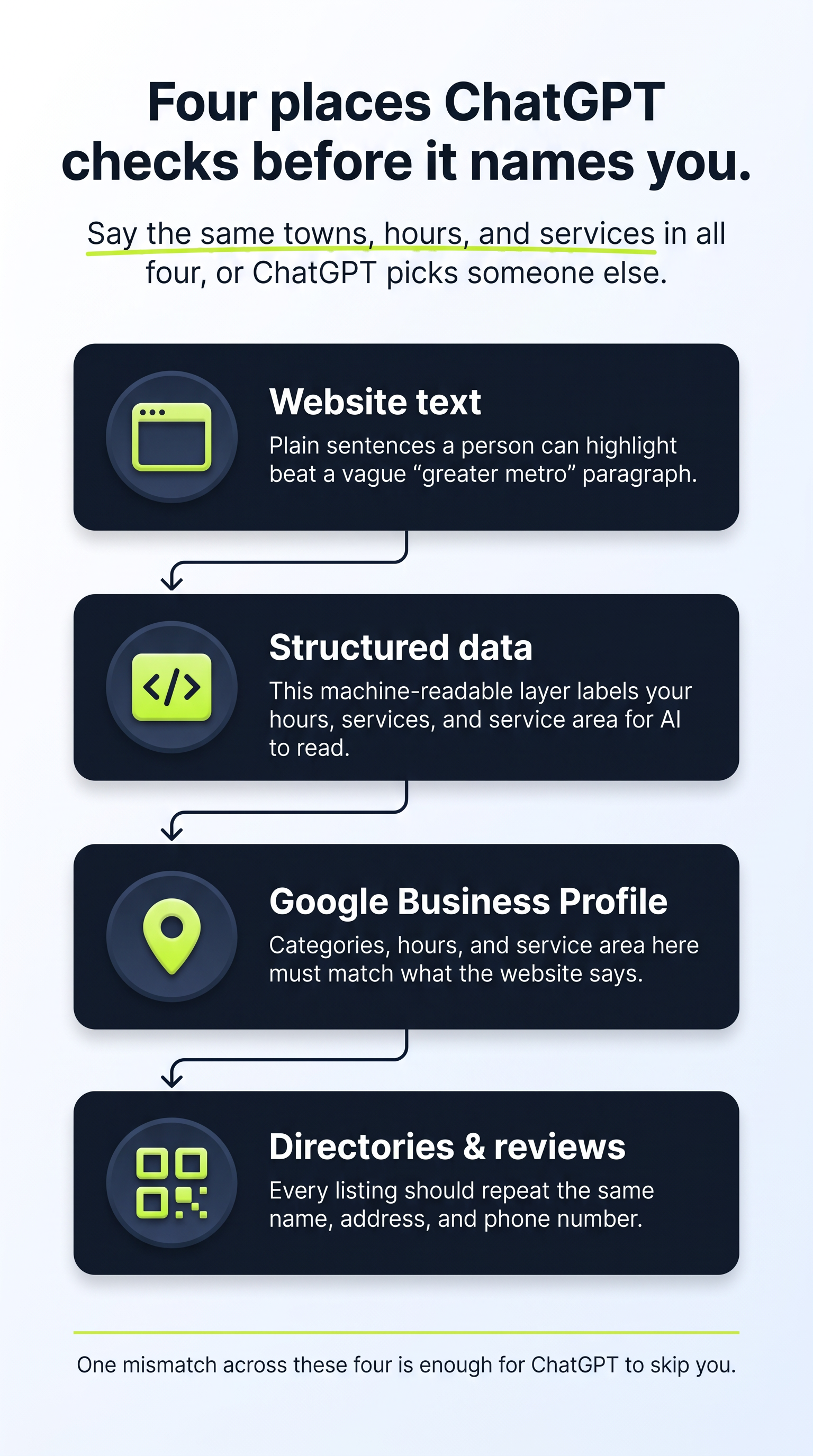
Think of four surfaces that have to agree.
First: Website text a person can highlight. The towns you serve, the hours you answer the phone, and the services you sell, written in plain sentences on the pages people land on. Second: Machine-readable facts on the page. Structured data (also called schema) is the machine-readable layer behind the page. It labels which strings are an address, which are hours, which are services, and which are ratings, instead of hoping the model guesses from a marketing paragraph. Third: Google Business Profile. Categories, service areas, hours, and phone that match what the site says. Fourth: Directories and reviews. Third-party listings and review sites that repeat the same name, address, and phone (NAP: name, address, phone).
Search Engine Journal's reporting on schema and local AI citations puts the practical rule this way: structured data helps label hours, location, services, and ratings; keep webpage facts, structured data, the Google Business Profile, and third-party corroboration accurate and consistent where you can. Google Business Profile "service area" and the matching service-area fields in structured data are different fields answering different questions, so fill each correctly for its definition rather than copying one into the other blindly. In one reported ChatGPT example, services lived in schema and the Google Business Profile even when the landing page text itself was thin, and two of three sources were enough for ChatGPT to return those services. Google has said structured data is not required for AI features, and still recommends it. The owner move is still the same: do not leave core facts inconsistent across the surfaces machines actually read.
How does a strong map listing still lose the AI answer?
Picture an HVAC owner whose trucks cover several suburbs. The Google Business Profile sits near the top of the map for "AC repair" in the main city. Reviews are recent. Photos look good.
A homeowner in one of those suburbs asks ChatGPT who to call for same-day cooling. The answer names a competitor with fewer reviews. The owner screenshots the map results, baffled.
What machines could read about that first company was thinner than the map suggested. The site said "serving the greater metro area." Hours lived in a graphic. Service pages listed equipment brands but not town names. Structured data had an old phone number. The Google Business Profile included towns the website never named. Directories still showed a previous suite number.
Say you pay for a click that never turns into a booked job, and ChatGPT never names you for that suburb either. Related reading when the assistant invents a cost story: Gemini told a plumber his free calls cost money.
What should you fix first on the site and the listing?
Start with the questions a homeowner actually asks an assistant, then make the answers match everywhere you control.
- "Who does emergency plumbing in [town]?"
- "What HVAC company covers [town] and [next town]?"
- "Are they open Saturday?"
- "Do they install heat pumps or only repair?"
Towns. Name the cities and neighborhoods you truly serve in sentences a person can copy. Fill structured data service-area fields and the Google Business Profile accurately for what each field means; they are not automatic twins. Prefer named towns over vague metro language.
Hours. Put open and close times in text or a simple table, not only in an image. Keep those hours accurate on the Google Business Profile too. If Saturday is on-call only, say so in words.
Services. List the jobs you want the phone to ring for. Keep category choices on the Google Business Profile honest. If schema and the landing page disagree about what you sell, fix the mismatch.
NAP. Keep one legal name, one phone path, and one address story across the site, schema, Google Business Profile, and major directories.
Then work the pass in this order:
First: Write a short service-area section in plain text on the homepage or a dedicated area page. Name each town you book so coverage is explicit. Second: Put hours in text next to the phone number. Keep the same open days and times accurate on the Google Business Profile. Third: Align services. One list of the jobs you sell, repeated in page copy, structured data, and Google Business Profile categories without inventing specialties you do not run. Fourth: Add or repair structured data so your business type, map pin, opening hours, and service area are labeled for machines: address, hours, and services readable without scraping a PDF or an image. Fifth: Reconcile directories and review profiles so NAP matches. Fix the old suite number before you buy another review campaign. Sixth: Run a ChatGPT spot check for each town you named. Record the model, date, your location, and the exact wording. Repeat once in a fresh session. Compare who it names to who sits in your map results, then verify any sources it cites before you treat a difference as a website or listing defect.
This is not a six-month redesign. It is a consistency pass. Whitespark's intent split is useful here: local-only queries often stay in map land; informational and hybrid questions are where AI Overviews show up most. If your towns and services are missing from the machine-readable layer, you leave less for AI answer tools to evaluate on questions that do not start with a map pin.
How do you check what AI says about you this week?
Do a spot check yourself before you buy another "AI SEO" package.
- Open ChatGPT and, separately, Google's AI answer box on a few searches. Treat them as different products.
- Ask: "Who should I call for [your main service] in [town you serve]?" Write down the model, date, location, and exact wording.
- Repeat for two more towns on your truck route and one town you do not serve (control). Run the ChatGPT asks once more in a fresh session.
- Note whether your company appears, which other company appears, and which facts look wrong (hours, services, coverage). If ChatGPT cites a source, open it before you act.
- Open your site in another tab and try to highlight the town names, hours, and services visitors can see. Then check schema and the Google Business Profile separately before you diagnose a gap.
- Open your Google Business Profile and confirm service area, hours, and categories match that highlightable text.
- After you fix mismatches, repeat the same recorded questions. Keep the screenshots.
If you want that footprint read without turning it into a weekend project across every phrasing a homeowner might use, Search Checkup is built to show what AI says about your company beside the rest of your local search picture. Use it when you want the comparison in one place. Either way, rerun the same recorded ChatGPT and AI Overview checks and compare who gets named.
Frequently asked.
Can I rank in the map results and still be missing from ChatGPT?
Yes. Map results lean on your Google Business Profile, reviews, and local relevance. ChatGPT is a different product; check it separately, and make towns, hours, and services readable in website text, structured data, the Google listing, and directories.
What is structured data?
Structured data (schema) is the machine-readable facts behind the page. It labels which text is an address, which are hours, which are services, and which are ratings so search engines and AI tools do not have to guess from a marketing paragraph. Google has said it is not required for AI features, and still recommends it.
Which four places have to agree for AI answers?
Website text a person can highlight, machine-readable facts on the page, your Google Business Profile, and third-party directories or reviews. Keep core facts accurate and consistent across those surfaces; in one reported example, two of three sources were enough when schema and the profile carried services missing from the landing page.
What should I ask ChatGPT when I check my company?
Ask who to call for your main service in each town you serve, then repeat for a town you do not cover as a control. Record the model, date, location, and exact wording, and repeat once in a fresh session. Compare the answer to who sits in your map results, verify any cited sources, and only then treat a difference as a website or listing defect.